





Imagine spending thousands of dirhams per month on Instagram ads, LinkedIn promotions, influencer marketing, content creation, and social media management. Then, imagine your CEO asking this single question at the end of each month:
“What exactly are we getting in return?”
All of a sudden, the numbers on likes, shares, comments, and followers in monthly reports lose their appeal.
This is one of the most challenging problems faced by companies in Dubai today. The marketing team needs to convince management that not only are social media platforms driving traffic but also helping to drive revenue.
And they’re right to ask.
A successful viral post is good. Millions of impressions are even better. However, if none of the above is driving leads, making sales, acquiring new customers, or helping businesses grow, is there any use at all?
The problem is that businesses in Dubai invest lots of money in social media without having an effective measurement strategy in place. It prevents them from allocating budgets, optimizing campaigns, and scaling a winning strategy.
That’s where understanding how to measure social media ROI becomes essential.
In this guide, you will learn how to calculate the ROI of social media marketing, what metrics matter, what tools you need, and how businesses in Dubai can make social media marketing a tool for growth rather than a branding cost.
What Is Social Media ROI?
Social Media ROI (Return on Investment) is an estimate of the benefits received by the business from social media activity relative to investment.
In simpler terms,
Social Media ROI helps answer the question, “How much value did we get for each dirham that we invested into social media?”
That value can take many different forms:
- Revenue
- Leads
- Website traffic
- App downloads
- Event registrations
- Customer acquisitions
- Email signups
- Brand awareness
It all depends on the objectives of your business.
For instance:
- ROI for a real estate firm in Dubai would be measured against the number of leads generated.
- ROI for an eCommerce firm would be measured against actual sales on their website.
- ROI for a B2B firm would be measured against leads generated and consultations booked.
The key is aligning ROI measurement with business outcomes rather than vanity metrics.
Why Measuring Social Media ROI Matters
Businesses continue to emphasize the following metrics:
- Likes
- Followers
- Shares
- Reach
- Impressions
Though these metrics have their significance, they do not necessarily prove their contribution to the business.
Measurement of ROI is essential for helping businesses:
Justify Marketing Budgets
Managers prefer to make data-driven decisions.
Proof of ROI makes it simpler to receive future funding.
Improve Marketing Performance
Measurement of ROI shows whether campaigns yield success or are money-wasting.
Optimize Resource Allocation
It is possible to allocate additional resources to the most profitable marketing channels.
Support Business Growth
ROI metrics establish a link between social media activities and revenue generation.
Make Better Strategic Decisions
Decisions become more evidence-based than guesswork.
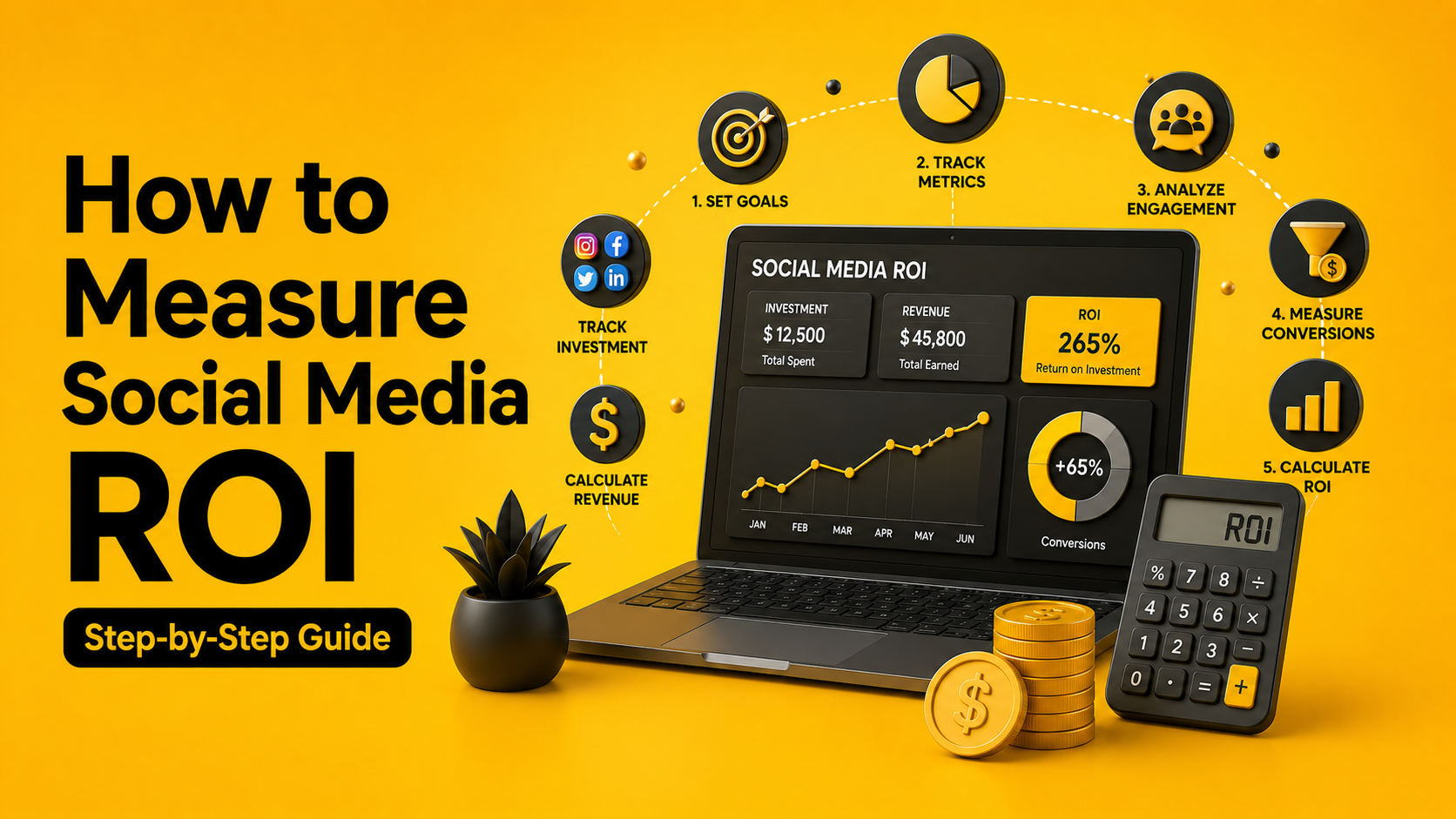
The Social Media ROI Formula
The most common formula used is as follows:
Social Media ROI (%) = ((Return – Investment) ÷ Investment) x 100
Now let us understand this through an example.
Example:
A fashion retailer in Dubai invests:
- AED 10,000 on social media advertising
- AED 5,000 on content creation
- AED 5,000 on social media management
Total investment made:
AED 20,000
Results:
Sales revenue attributable to the social media campaign is AED 80,000
Calculation:
((80,000 – 20,000) ÷ 20,000) x 100
ROI = 300%
This means the business earned AED 3 for every AED 1 invested.
What Counts as Social Media Investment?
To determine ROI, one needs to know what the overall investment costs are. Most companies underestimate their social media spending.
Typical investments may include:
- Advertising Costs
- Meta Ads
- LinkedIn Ads
- TikTok Ads
- YouTube Ads
- X (Twitter) Ads
- Content Creation
- Graphic design
- Video production
- Photography
- Copywriting
- Agency Fees
- Social media management
- Campaign execution
- Strategy development
- Influencer Marketing
- Creator fees
- Sponsored collaborations
- Product gifting
- Software and Tools
- Scheduling tools
- Analytics platforms
- CRM integrations
- Employee Costs
- Social media managers
- Marketing executives
- Content creators
All costs related to the investment need to be considered for a proper ROI calculation.
What Counts as Social Media Returns?
Returns depend on the objectives of your business. Some returns are direct. Other returns are indirect.
Direct Returns
These are easiest to measure.
They include:
- Product sales
- Subscription purchases
- Service bookings
- Course enrollments
Lead Generation Returns
For most businesses in Dubai, social media is a lead generator, not a sales one.
They include:
- Real estate inquiries
- Consultation requests
- Demo bookings
- Form submissions
Website Traffic Value
Value depends on the conversion rate of website visitors to customers.
Customer Lifetime Value (CLV)
The customer acquired by social media may buy from you for years to come. It is important to take into consideration.
Brand Awareness
While difficult to measure, brand awareness provides future revenue sources.
How to Track Social Media ROI Effectively
Understanding how to calculate social media return on investment, it is necessary to understand the relationship between social media activities and the business performance.
Here are the best ways to do that.
1. Set Clear Business Goals
Firstly, define your success criteria.
Examples include:
- 100 leads per month
- An increase in online sales by 20%
- 5,000 site visitors
- 50 customers gained
ROI cannot be calculated without objectives.
2. Use UTM Parameters
UTM tracking codes enable tracking of all the marketing campaigns.
Examples include:
Not only can we track the website visitors, but also
- From which social network they come
- Which campaign was successful in driving the conversions
- What posts provided the best ROI
All these actions can be done using Google Analytics.
3. Configure Conversion Tracking
Conversions are important for every business.
They may include:
- Purchases
- Contact form submissions
- Phone calls
- Appointment scheduling
- Newsletter subscription
Conversion tracking is necessary to track ROI.
4. Connect CRM Data
Firms that use CRM software get more visibility.
Some popular ones are:
- HubSpot
- Salesforce
- Zoho CRM
CRM integration allows you to identify:
- Quality of leads
- Sources of customers
- Revenues associated with each lead
This helps provide better ROI analysis.
5. Track Customer Journeys
Customers usually do not make purchases on first contact.
They might:
- Find your company through Instagram
- Visit your website
- Read blogs
- Sign up for emails
- Make a purchase weeks later
Attribution modeling allows tracking this journey.
Key Metrics for Measuring Social Media Marketing ROI
In order to measure social media marketing ROI, pay attention to metrics associated with the results of your work.
Conversion Rate
Metric used to calculate how many website visitors perform the required action.
Calculation:
Number of Conversions ÷ Number of Visitors × 100
Higher conversion rate usually means good ROI.
Cost Per Lead (CPL)
Metric shows how much money you spend for one lead.
Calculation:
Total Costs ÷ Number of Leads
Lower CPL increases profitability.
Customer Acquisition Cost (CAC)
Metric showing the cost of acquiring one customer.
Calculation:
Marketing Costs ÷ New Customers
Comparing CAC and customer value is extremely useful.
Customer Lifetime Value (CLV)
Metric calculating the total earnings from one customer throughout his/her lifetime.
High CLV allows spending more on customer acquisition.
Revenue Attribution
The metric showing what share of revenue was generated by social media channels.
Very important for ROI calculation.
Return On Ad Spend (ROAS)
Calculation:
Revenue ÷ Advertising Costs
ROAS is all about measuring the performance of paid ads.
Best Tools for Tracking Social Media ROI
There are many tools to help with the measuring and reporting process.
Google Analytics 4
Measures:
- Website traffic
- Conversions
- User behavior
- Revenue attribution
- Meta Business Suite
Measures the performance of:
- LinkedIn Campaign Manager
Suitable for B2B businesses aiming at professional customers.
HubSpot
Helps measure everything from the beginning to the end.
Hootsuite
Measures engagement, conversion, and campaign performance.
Sprout Social
Features analytics, reporting, and social media management.
Social Media ROI Calculator: How to Calculate ROI Quickly
Many businesses use a simple social media ROI calculator approach.
Step 1
Calculate total investment.
Example:
Ads: AED 10,000
Content: AED 3,000
Management: AED 2,000
Total:
AED 15,000
Step 2
Determine revenue generated.
Revenue:
AED 60,000
Step 3
Apply the formula:
((60,000 – 15,000) ÷ 15,000) × 100
Result:
300% ROI
This means every AED 1 invested generated AED 4 in total revenue.
Common Mistakes Businesses Make When Measuring Social Media ROI
Focusing Only on Vanity Metrics
Likes and follower counts do not guarantee sales. Corporate results should be considered more.
Ignoring Attribution
Many companies cannot relate social activities to conversion rates. This will lead to misleading information.
Measuring Too Early
Some social media activities need time before yielding results. Performance assessment should not be made too soon.
Excluding Hidden Costs
Employee time, software subscriptions, and content creation expenses must be considered.
Tracking the Wrong KPIs
Ensure that all metrics are related to business objectives.
How to Improve Your Social Media ROI
Measuring ROI is only half the battle. The real goal is to constantly work to increase it.
Unfortunately, many companies from Dubai spend money on social media but do not analyze the performance of their social media campaigns and do not optimize them.
Ways to increase your social media ROI are as follows:
Focus on High-Performing Platforms
Not all platforms bring the same results.
For instance:
- LinkedIn may give you higher-quality B2B leads.
- Instagram may convert better for lifestyle brands.
- TikTok may give better results for young people.
- Facebook can be still efficient for local targeting.
Use platform-specific data and invest more in high-converting channels.
Create Content for Every Stage of the Buyer Journey
Some companies create only awareness content.
To increase your ROI, you should also develop:
- Awareness content (posts, videos, blog posts)
- Consideration content (case studies, testimonials, comparison)
- Decision-making content (special offers, demos, consultations, etc.)
This helps move prospects through the sales funnel more efficiently.
Use Retargeting Campaigns
Only a few people will convert on their first visit.
Through retargeting, you will be able to reach out to:
- Website visitors
- Video watchers
- Abandoned cart users
- Social media engagements
These people are already aware of your brand and therefore have higher chances of converting.
Leverage AI and Automation
AI can now do all of this for you:
- Target ads better
- Forecast behavior
- Personalize user experience
- Manage campaigns
It is not only time-efficient but it makes campaigns perform better too.
Continuously Test and Optimize
The best performing businesses are always testing something.
Variables that can be tested include:
- Ads themselves
- Headlines
- CTAs
- Target audience
- Landing pages
Even minor improvements in conversion rates make a difference in your ROI.
Align Social Media with Business Goals
Your social media campaign should always serve a certain business objective.
Instead of asking yourself, “How many likes have we gotten?”
Ask:
- How many leads were generated?
- How much revenue was attributed?
- How many customers were acquired?
If the work on social media aligns with business objectives, then ROI becomes much clearer.
Social Media ROI in Dubai: What Businesses Need to Know
Dubai’s market is highly competitive and digitally connected. People often do their research about brands on various platforms before buying something.
This is why attribution becomes so important.
It is especially important for businesses operating in the industries such as:
- Real estate
- Hospitality
- Healthcare
- E-commerce
- Professional services
- Education
It is important to know precisely how the use of social media helps them grow. Not all the companies that get the largest returns spend the most money. They just measure their efforts well, optimize them, and use data.
The Future of Social Media ROI Measurement
Artificial intelligence is revolutionizing the way people measure their marketing efforts.
Today’s platforms can:
- Predict the conversion rates
- Recognize high-quality audiences
- Report automatically
- Increase the accuracy of the attribution process
- Optimize the ad campaigns automatically
With time, artificial intelligence will change measurement for the better even more.
Conclusion
Social media marketing is no longer about likes, comments, and followers.
It is about growing your business in a measurable way.
Knowing how to measure social media ROI will help you learn what works, cut off any ineffective expenses, and make your marketing efforts work better.
If you know which metrics to track, know proper attribution techniques, and tie social media efforts with results in terms of revenue, then you can grow your business with the help of social media instead of guessing.
As far as success goes, it does not depend on attracting as much attention as possible.
Success depends on having the highest possible return from marketing efforts.