




Are your competitors still showing up ahead of you when someone searches for the exact service you offer? That’s the frustrating part of search marketing. Being good at what you do doesn’t automatically make you visible on Google.
And in a market like Dubai, where businesses are constantly competing for attention, waiting for customers to stumble across your website isn’t much of a strategy.
This is where SEM (Search Engine Marketing) comes in.
SEM can put your business in front of people who are already searching for what you sell. But there’s a catch: paying for visibility doesn’t guarantee results. The wrong keywords, weak ad copy, or a poor landing page can turn a perfectly healthy advertising budget into a very expensive lesson.
So, how does SEM actually work, and how can you make it work for your business?
Key Takeaways
- With SEM, you get in touch with people who have been searching for your product or service.
- It is not important to get more clicks; it is more important to make your advertisements relevant for those who really need them.
- A good advertisement needs a good landing page, where you can convert your clickers to clients, patients, subscribers, or buyers.
- SEM and SEO are complementary to each other, so that they both will provide you with fast success and sustainable growth.
What Is SEM?
SEM stands for Search Engine Marketing. Today, the term is generally used for paid advertising on search engines, particularly paid search campaigns through platforms such as Google Ads.
The idea is fairly simple. Say you run a property management company in Dubai. A potential customer searches for “property management company Dubai”
If you’re running an SEM campaign targeting that search, your ad could appear prominently on the results page. The customer clicks, visits your website, and, hopefully, gets in touch. That’s the basic journey:
Search → Ad → Click → Website → Enquiry or Sale
Most SEM campaigns use a pay-per-click (PPC) model, so you generally pay when someone clicks your ad.
The easy part is getting the ad in front of someone. The harder part is making sure that person is actually worth reaching, and giving them a good reason to choose you.
How Does SEM Work?
There’s more to SEM than choosing a few keywords and writing an ad. It starts with the right search.
Think about how people search when they’re ready to buy. Someone typing “what is property management?” is probably looking for information. Someone typing “property management company Dubai” has a very different mindset. They may already be comparing providers.
That difference is called search intent, and it matters enormously in SEM.
You don’t want to pay for every possible search related to your industry. You want to show up for searches that have a realistic chance of bringing you business.
For a Dubai company, relevant searches might look like:
- “digital marketing agency Dubai”
- “villa for rent Dubai”
- “office cleaning services Dubai”
- “car rental Dubai”
- “SEO services Dubai”
The best keyword isn’t necessarily the one with the biggest search volume. Sometimes, a smaller keyword with stronger buying intent is worth much more.
Then comes the auction. Once you know which searches you want to target, your ads enter Google’s advertising auction. Your bid is one part of the equation, but it isn’t the whole story. Factors such as ad relevance and landing-page experience also matter.
So no, the business with the biggest budget doesn’t automatically win every search.
That’s good news for smaller businesses. A well-targeted campaign can compete without trying to outspend everyone in sight. Your ad has to do some convincing. You only have a few lines to make someone care.
Compare “Digital Marketing Services” with “Digital Marketing Agency in Dubai | Generate Better Leads”
The second one tells the searcher what you do, where you operate, and what they might get from working with you. That’s what good SEM copy should do. No grand promises. No unnecessary jargon. Just a clear reason to click.
And then there’s the landing page.
This is where many campaigns quietly lose money.
Imagine searching for “Dubai corporate catering”, clicking a relevant ad, and landing on a generic homepage. Now you have to find the catering service yourself, figure out what the company offers and work out how to contact them.
Your landing page should pick up exactly where the ad leaves off. If the ad talks about corporate catering, the page should talk about corporate catering.
And the next step should be obvious:
- Request a Quote.
- Book a Consultation.
- Call Now.
Don’t make potential customers play detective.
Finally, measure what actually matters.
A campaign getting thousands of clicks might look impressive in a report. But if those clicks aren’t producing leads, bookings, or sales, what are you really celebrating?
SEM lets you track metrics such as clicks, CPC, CTR, conversion rate, cost per conversion, and ROAS. The useful part isn’t simply having all that data. It’s using it to decide what to change.
SEM vs SEO: What’s the Difference?
SEM and SEO are often mentioned in the same breath, which is understandable. Both are about getting your business seen when people search online.
The difference is how you get there.
SEO focuses on organic search visibility. SEM, in its modern usage, generally refers to paid search visibility.
| SEO | SEM |
| Organic search visibility | Paid search visibility |
| Takes time to build | Can provide faster visibility |
| Focuses on content, technical SEO, and authority | Focuses on ads, keywords, bids,s and landing pages |
| Built for long-term organic growth | Useful for targeted, immediate campaigns |
There is some confusion around the term itself because SEM was historically used as a broader label for search marketing, including SEO.
But terminology aside, the two can work quite well together.
You can use SEM to capture demand today while your SEO strategy works towards stronger organic visibility over time.
Why SEM Makes Sense in Dubai
Dubai is a competitive place to do business. That’s not exactly breaking news.
Whether you’re selling property, running a restaurant, offering professional services, or managing an e-commerce business, there are plenty of companies fighting for the same customer’s attention.
Search gives you an interesting advantage: you can reach people when they already have a need. Someone scrolling through social media might not be thinking about buying your service. Someone searching “best office cleaning company Dubai” is. That intent is valuable.
SEM can be particularly useful if you:
- Need leads quickly
- Are launching a new service
- Want to promote a specific offer
- Operate in a competitive industry
- Want to target particular locations
- Need to reach people actively searching for your service
Instead of trying to convince everyone that they need you, you’re meeting people who are already looking for something you provide.
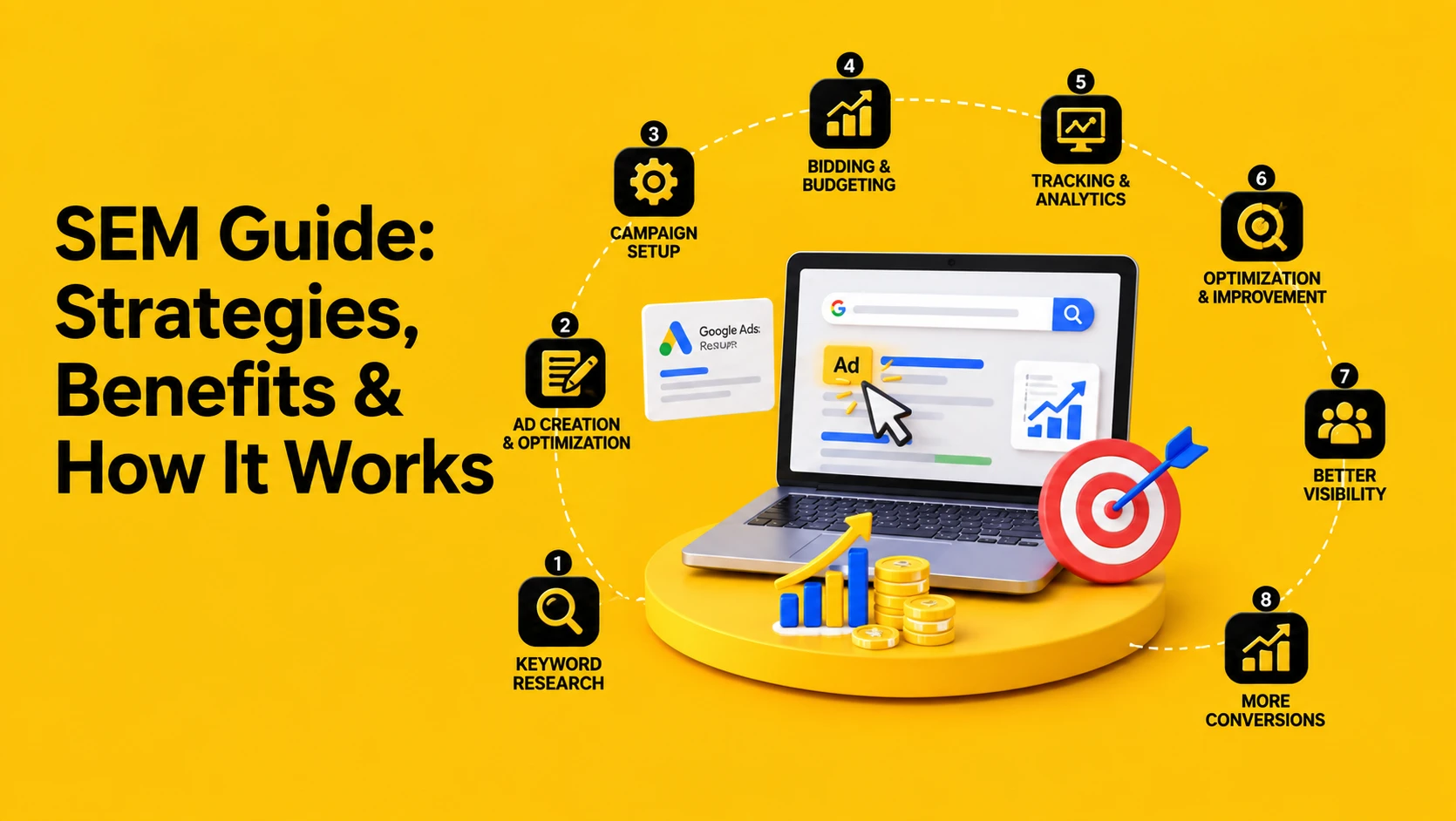
How to Set Up an SEM Campaign
Step 1 – Get Your Ad Account Ready
Set up your Google Ads account and start with a clear idea of what you want the campaign to achieve.
Step 2 – Find Keywords That Matter
Look for the terms your potential customers are actually using, especially searches that show they’re ready to take action.
Step 3 – Keep Things Organized
Group similar keywords and ads together so each ad speaks directly to what people are searching for.
Step 4 – Give Them Somewhere Useful to Go
Don’t send every click to your homepage. Take visitors to a relevant landing page that answers their needs and makes the next step easy.
Step 5 – Write Ads People Want to Click
Keep your headlines and descriptions clear, specific, and focused on what makes your business worth choosing.
Step 6 – Set Your Audience and Budget
Choose where and who you want to reach, then start with a budget you’re comfortable testing.
Step 7 – Launch, Learn and Improve
Once your campaign is running, watch what’s bringing results. Keep the keywords, ads, and budget that work, and rethink what doesn’t.
What Makes SEM Worth the Investment?
It gets you visible faster.
Organic rankings don’t happen overnight.
Paid search can give a new campaign visibility much sooner once the ads are approved. That’s useful when you’re launching a service, running a promotion, or simply don’t want to wait months to start generating search traffic.
You have control over your targeting
You don’t need to advertise to everyone.
You have the ability to select what type of searches you want to target and use negative keywords to exclude those that do not matter. This will ensure that your budget is spent on sensible searches.
You can see where your money is going.
When you have proper tracking set up, you can see the performance of your campaigns and what you get in return. That makes SEM much less of a guessing game.
You can identify which keywords bring leads, which ads get attention, and which parts of your campaign need work.
Building an SEM Strategy That Doesn’t Waste Money
Before launching a campaign, answer one question:
What do you actually want the campaign to achieve? More calls? More bookings? Product sales? Lead generation? Start there. Then build your keyword strategy around that goal.
Don’t automatically chase keywords with huge search volumes. Ask whether the person behind the search is likely to become a customer.
Keep related keywords together so your ads stay relevant. Create landing pages that match what people searched for. And make sure conversion tracking is working before you start spending seriously.
Most importantly, don’t treat your first campaign as the finished product.
SEM works best when you keep learning from the data. One ad might outperform another. One keyword might bring expensive clicks but no leads. Another might quietly bring three excellent customers every week. Follow the evidence.
SEM Mistakes That Can Cost You
A few common mistakes can make SEM unnecessarily expensive.
- Going too broad: More traffic isn’t automatically better traffic.
- Ignoring negative keywords: Irrelevant searches can eat into your budget surprisingly quickly.
- Sending every visitor to the homepage: Your homepage isn’t always the right destination for a paid search visitor.
- Measuring clicks instead of customers: A click is only valuable if it contributes to your business goal.
- Forgetting mobile: If your landing page is awkward to use on a phone, you’re making it harder for people to convert.
- Leaving campaigns untouched: Search behavior, competitors, and performance change. Your campaigns should change with them.
Is SEM Right for Your Business?
SEM can be a smart investment if your customers actively search for the products or services you offer and you want to capture that demand sooner.
But don’t think of it as a replacement for SEO. The two solve different problems. SEM can help you get in front of customers now. SEO can help you build organic visibility for the long haul.
For a business in Dubai, combining the two can create a much stronger search presence than relying entirely on one.
The Bottom Line
SEM isn’t really about getting an ad to the top of Google.
It’s about showing up at the moment someone is looking for what you sell, and giving them a good enough reason to choose you.
The difference between a campaign that burns through a budget and one that brings in business often comes down to the details, the keyword you target, the message in the ad, the page you send people to and what you do with the data afterward.
If you’re ready to make search work harder for your business, Xparro can help you build an SEM strategy focused on qualified traffic, meaningful leads, and measurable growth.
FAQs
1. Is SEM the same as SEO?
Not exactly, but both can be combined effectively to achieve great results.
2. Is SEM worth it for a Dubai business?
If people who buy your product or service use the Internet to look for it, then yes, it is very useful for you to use SEM.
3. How much does SEM cost?
SEM price depends on many things: competitiveness of your market, keywords, localization of your business, and others. It is essential that your money is spent effectively.
4. How quickly can SEM deliver results?
Results from SEM can come faster than from SEO, but getting leads and orders requires optimization and testing.