



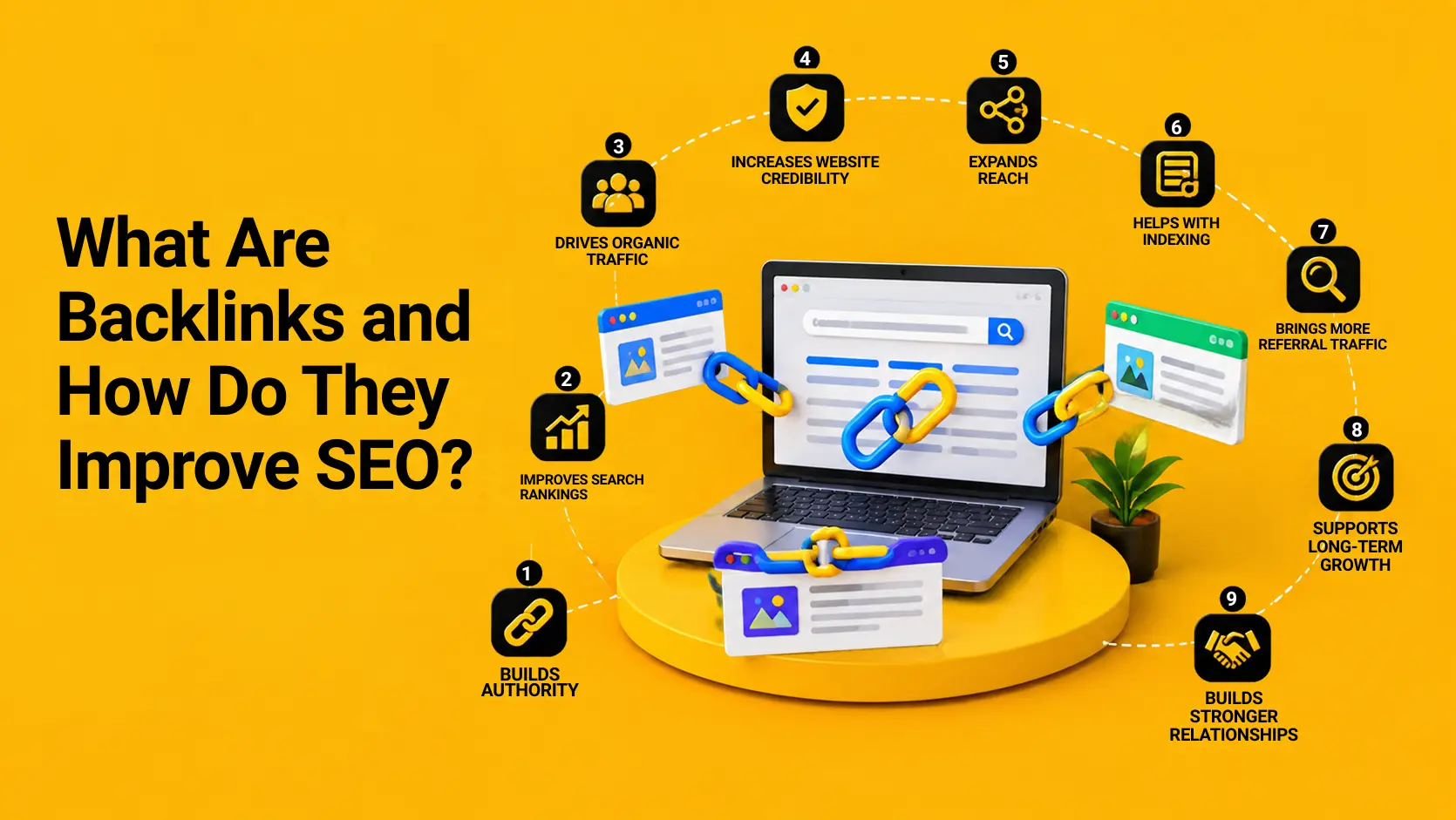
Google looks at what happens outside your website too. And one of the biggest pieces of that puzzle is backlinks. A backlink is simply a link from another website to yours. It may sound basic, but the right backlink can tell Google that your website is trusted, relevant, and worth showing to more people.
For a business in Dubai, where almost every industry is crowded online, that extra credibility matters.
But there’s a lot of confusion around backlinks. Some businesses think they need thousands of them. Others buy packages promising hundreds of links overnight.
That’s not how it works.
So, let’s forget the complicated SEO jargon for a moment and look at what backlinks actually mean, why they matter, and how you can build them properly.
Key Takeaways:
- Backlinks are basically links on other sites leading to your site, and having the right ones will help your site gain more credibility.
- Don’t focus on having lots of backlinks; a few relevant ones will go further than hundreds of irrelevant ones.
- Ways to earn backlinks include writing share-worthy content, gaining exposure, building relationships within the industry, and spotting opportunities.
- While backlinks will improve your SEO performance, they should work together with other aspects of your SEO efforts.
What Is a Backlink?
Let’s say you own a digital marketing agency in Dubai.
A UAE business publication writes an article about digital marketing and links to one of your guides. That link pointing from their website to yours is a backlink. You can think of it as an online recommendation.
If a respected business owner tells someone, “You should speak to this company,” you’re probably going to give that company a second look.
A backlink works in a somewhat similar way online.
When another website links to your content, it can be a signal that your content is useful or trustworthy. Links are also one of the ways search engines understand relationships between websites and pages.
Google doesn’t see one backlink and immediately decide, “Yes, this is number one!” SEO is never that simple. But backlinks can become an important part of the bigger picture.
Why Do Backlinks Matter for SEO?
This is where SEO and backlinks come together.
You can optimize every page on your website perfectly. You can choose the right keywords and publish useful content. But Google still needs signals that your website deserves to be trusted. Backlinks can help provide those signals.
They can help build authority
Imagine two websites offering similar services. One has been mentioned by several respected websites and industry publications. The other has never been mentioned anywhere.
Which one feels more established? That’s the basic idea behind backlinks. A handful of genuinely good links can be much more useful than hundreds of random ones.
They can help with search visibility
Search engines use links as part of their systems for understanding the importance and connections between web pages.
If your website has poor content, technical problems, or doesn’t match what people are searching for, backlinks won’t magically fix everything.
Think of them as one part of the puzzle.
They can bring people to your website
Here’s something worth remembering:
Backlinks aren’t just for Google. Suppose a popular Dubai business website publishes a useful article and links to your service page.
People reading that article might click your link. Those visitors could become inquiries, customers, or followers. And that’s valuable traffic coming directly from another website.
They can make your brand look more credible
There’s a reason brands care about being featured in respected publications. Being mentioned by someone else can carry more weight than talking about yourself.
A website saying, “We’re experts” is one thing. A trusted publication, industry website, or organization referencing that business is another. Backlinks can be part of building that wider online credibility.
Are All Backlinks Good?
No. And this is probably the biggest thing businesses get wrong.
It’s tempting to think:
More backlinks = better SEO.
Unfortunately, it isn’t that simple.
Imagine someone offers you 1,000 backlinks from websites you’ve never heard of. Sounds impressive. Now imagine getting five links from respected websites in your industry. Which would you rather have? Exactly.
When it comes to backlinks, quality and relevance matter far more than a big number.
Relevance matters
If you’re a Dubai real estate company, a backlink from a property publication makes sense.
A backlink from a website about pet food? Not so much. The more relevant the website and content are to your business, the more natural the link feels.
Trust matters
Would you trust the website yourself?
That’s a surprisingly useful question.
If a website looks spammy, has endless advertisements, publishes completely unrelated articles, and exists mainly to sell links, you probably don’t want it linking to your business.
A backlink should come from a website that has some genuine value.
Context matters
Where the link appears matters too.
A link naturally included in a useful article makes sense. A random link stuffed into a page alongside 50 unrelated links doesn’t. The best backlinks usually feel like they belong there.
Because they do.
What Types of Backlinks Are There?
You don’t need to memorize a huge list of backlink types.
But knowing the basics helps.
- Editorial backlinks are backlinks to your content created by other websites that find it valuable.
- Guest post backlinks are earned through publishing valuable content on another website.
- Directory backlinks can be received from reputable business directories, local listings, or associations within your industry.
- Digital PR backlinks are generated through media coverage of your research, campaigns, announcements, and expertise.
You may also come across terms such as nofollow, sponsored, and ugc. These are link attributes that give search engines additional information about why or how a link was placed.
The important thing isn’t chasing one specific type. It’s earning links that actually make sense for your business.
How Can You Build Backlinks?
Now we get to the part that really matters.
How do you actually get people to link to your website? There’s no secret button. Good backlinks are usually earned by giving people a reason to mention you.
Create something worth sharing
This is probably the most sustainable approach. Don’t just create content because you need another blog this week. Create something people would actually want to reference.
For example, a Dubai e-commerce company could research online shopping trends in the UAE and publish the findings.
If the data is genuinely useful, other websites have a reason to reference it. And when they do, you earn backlinks naturally.
Give digital PR a shot
Got an interesting story? Don’t keep it hidden on your website. Pitch it. New research, unusual business trends, local data, expert opinions, and original insights can all make good PR material.
If a journalist or publication uses your research in their story, you could earn a valuable mention and backlink. And unlike buying a link, you’re earning attention at the same time.
Use your existing relationships
You may already know people who could potentially link to your website.
Think about your:
- Business partners
- Suppliers
- Clients
- Industry associations
- Event organisers
- Professional networks
Maybe you’ve collaborated on an event. Maybe you’ve completed a project together. Maybe you’re listed as a partner. There could be a perfectly natural reason for them to mention your business and link to your website.
Sometimes the easiest opportunities are the ones sitting right in front of you.
Find broken links
This one takes a little more work, but it can be effective.
You find a relevant website with a broken link. Then you have a useful piece of content that could replace what used to be there. Reach out to the website owner and point it out. You’re helping them fix a broken link, and they may choose to replace it with yours.
It’s much better than sending a random email saying, “Please give me a backlink.”
Look at what your competitors are doing
Your competitors can give you some useful clues.
Look at which websites are linking to them. You might find industry publications, local directories, blogs, or organizations that could also be relevant to your business. But don’t blindly copy every backlink. Some of their links may be useless.
The goal is to find good opportunities you can realistically earn.
Should You Buy Backlinks?
Short answer? Be very careful.
If someone promises:
“1,000 backlinks for AED 200.”
It might sound like you’ve just found the SEO bargain of the century. You haven’t. Buying links in bulk, participating in link schemes, or creating links specifically to manipulate rankings can violate Google’s spam policies.
And even if nothing dramatic happens, you may simply end up with a pile of useless links that do nothing for your business.
SEO isn’t about collecting as many backlinks as possible. It’s about building a website that other people genuinely want to reference. Five excellent backlinks can be more valuable than 500 irrelevant ones.
How Many Backlinks Do You Actually Need?
There’s no set number. Anyone telling you that you must get exactly 100 or 500 backlinks is oversimplifying SEO. Your competitors, industry, target keywords, website authority, and the quality of your links all matter.
Instead of asking “How many backlinks do we have?” ask “Are we getting the right backlinks?”
- Are reputable websites mentioning your business?
- Are relevant UAE websites linking to your content?
- Are competitors earning links you’re missing?
- Are those links bringing visitors?
- And, most importantly, is your organic visibility improving?
Those are much better questions.
SEO and Backlinks Work Best Together
Here’s the thing about backlinks: they can’t carry your entire SEO strategy.
Your website still needs good content. Your pages need to match search intent. Your technical SEO needs to be in order. Your website needs to load properly. And once someone lands on your site, they need to actually find what they’re looking for.
Think about it this way:
A backlink can bring someone to your door. Your website needs to give them a reason to walk in. That’s why backlinks should be part of a broader SEO strategy rather than treated as a standalone trick.
The Bottom Line
Backlinks aren’t dead. They aren’t a magic SEO button either. They’re simply one of the ways your website can build trust, authority, and visibility online.
For businesses in Dubai, the smartest approach is to focus on quality over quantity.
Create useful, original content. Build relationships with relevant businesses and publications. Look for genuine PR opportunities. Study your competitors. And don’t fall for offers promising thousands of backlinks overnight.
Because Google isn’t impressed by a big number sitting in your SEO report. What matters is where those links come from, why they’re there, and whether they actually make sense. Build backlinks people would genuinely want to click.
Build a website people would genuinely want to recommend. And let the SEO benefits follow.
Need help building a backlink strategy that actually makes sense for your business? Xparro can help you earn quality backlinks, strengthen your SEO, and build the online visibility your Dubai business deserves. Get in touch with Xparro, and let’s get your website the attention it deserves.
Frequently Asked Questions
- How do backlinks help with SEO?
Backlinks may help your website be perceived by Google as credible and relevant. Links from credible sources may be beneficial for search engine rankings and referral traffic as well.
- How many backlinks does a website need?
It depends on many factors. It is always better to have several quality and relevant backlinks rather than hundreds of irrelevant ones.
- What’s the best way to get backlinks?
One should create valuable content to earn organic backlinks. Backlinks can be acquired via digital PR, partnerships, guest blogging, business listings, etc.
- Can buying backlinks improve my rankings?
No, cheap or spammy backlinks may even harm your rankings. It would be better to use an organic backlink strategy instead.