

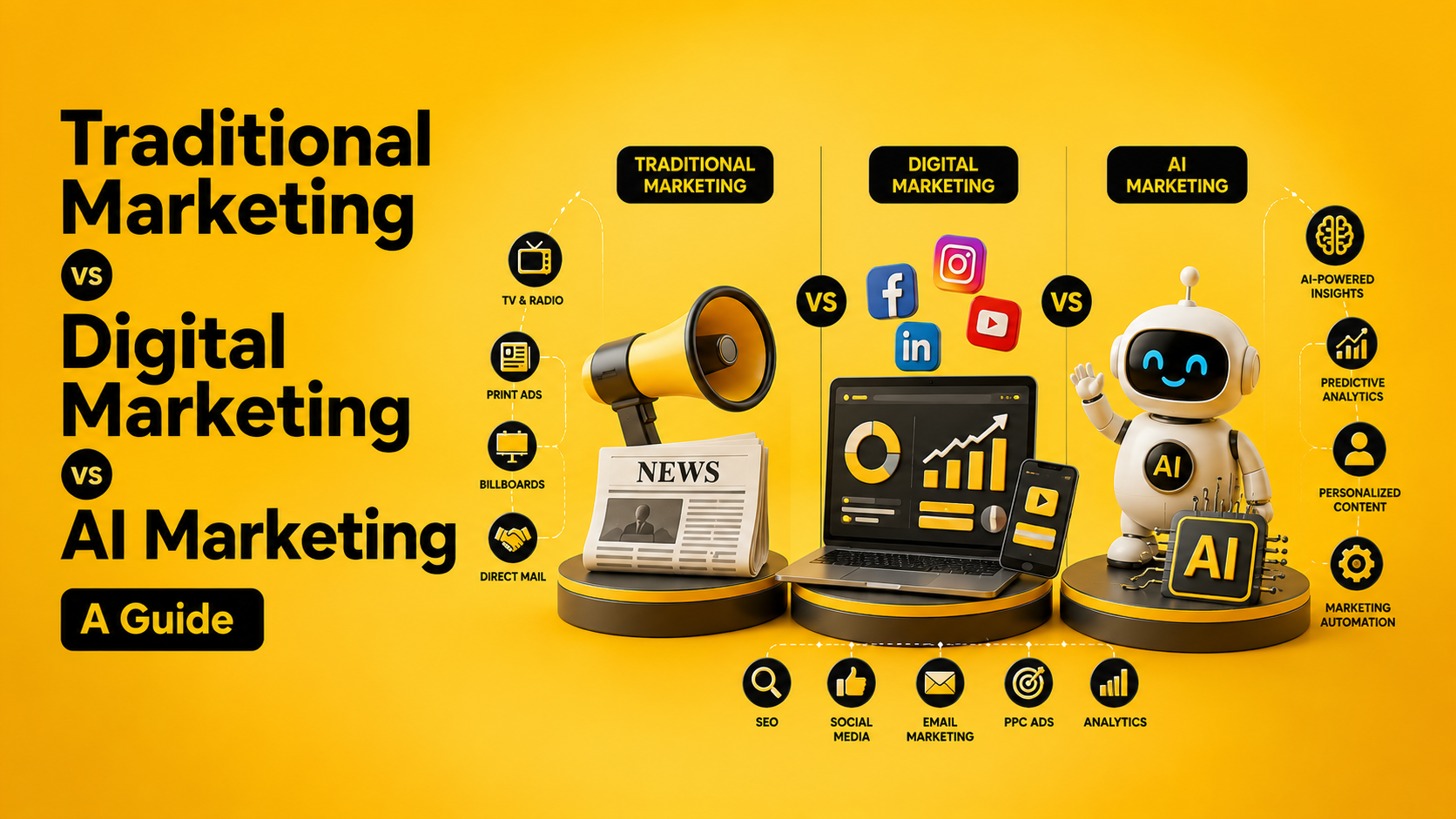
A decade ago, it was enough for an organization to print an ad in a local newspaper, stick a poster on Sheik Zayed Road, launch a radio campaign, and wait for customers to visit their stores.
Today, things are different.
In modern Dubai, potential buyers encounter companies through a Google search, an Instagram reel, a YouTube video, a recommendation by a WhatsApp friend, an artificial intelligence-led search, and other digital mediums. However, most businesses have a dilemma: should I use traditional marketing, digital marketing, or AI marketing?
The difficulty is that each firm is ready to convince you that its way of doing business is the best one. Traditional marketers talk about branding. Digital marketers emphasize clicks. Artificial intelligence marketing specialists speak about automation and predictiveness.
So which one actually works?
The answer depends on numerous factors like your goals, audience, budget, and growth stage, and understanding them can help you make better decisions regarding your marketing efforts.
| Factors | Traditional Marketing | Digital Marketing | AI Marketing |
| Definition | It promotes products using traditional media such as television, radio, print, and outdoor advertising. | It uses digital means to reach out to the target audience. | It uses artificial intelligence for marketing purposes. |
| Primary Objective | Achieving mass exposure for creating brand awareness. | Generating leads, building relationships, and conversions. | Predictive growth and one-on-one personalization. |
| Mediums Used | Television, radio, newspapers, magazines, events, flyers, and billboards. | Social media, websites, Google ads, content marketing, and email marketing. | AI chatbots, predictive analysis, automation, AI-driven search optimization, and recommendation engine. |
| Target Audience | Broad and not necessarily targeted. | Targeted based on demographics, interests, and behavioral insights. | Hyper-targeted using real-time data. |
| Personalization | Limited to some extent. | Uses personalization to a certain extent through segmentation. | Sophisticated one-on-one personalization through automation. |
| Efficiency | Economically inefficient and cost-prohibitive. | A modular budget that allows scalability. | Economically efficient after initial expenditure. |
| Measurements | Challenging to accurately measure. | Easy tracking and analysis tools. | In real-time tracking and analysis with predictions. |
| Campaign Optimization | Limited campaign optimization. | Real-time adjustment capabilities. | Automated self-optimization via machine learning. |
| Customer Engagement | One-way communication style. | Two-way digital communication. | Conversational interactions and engagements powered by artificial intelligence. |
| Execution Speed | Long lead times and delays. | Better campaign creation speed. | Optimum execution speed with instant adjustments. |
| Lead Generation | Difficult to attribute leads. | Highly measurable leads. | Predicts and prioritizes high-quality leads. |
| Data Utilization | Limited customer data usage. | Data usage for customers and campaigns. | Analyzing big data sets with powerful tools. |
| Automation Level | Very limited. | Partial automation features. | Automates marketing processes extensively. |
| Scalability | Limited due to budget constraints. | Easy scalability and geographical expansion. | Easy to scale up with minimum manual efforts. |
| Return on Investment | Measured indirectly and estimated. | Measurable with accuracy. | Prediction-based ROI measurement and improvement. |
| Appropriate For | Brand awareness and geographic reach. | Perfect for SMEs, services, and e-commerce businesses. | Growers and enterprises in all types of business models. |
| Main Shortcoming | Expensive and difficult to measure. | Medium competition and heavy dependence on algorithms. | Lacks quality data, AI knowledge, and human control. |
| Future Prospects | A supportive branding tool. | Main marketing tool. | Main tool for the future. |
What is Traditional Marketing?
Traditional marketing is marketing conducted through means that do not involve online methods of reaching out to prospective clients.
Before the internet, which significantly impacted consumer purchasing habits, traditional marketing served as the principal means for organizations to build visibility and generate sales.
Traditional marketing includes:
- TV commercials
- Radio commercials
- Newspaper ads
- Magazine ads
- Billboards
- Leaflets and brochures
- Direct mail marketing
- Event sponsorships
- Trade shows and exhibitions
For several decades, such marketing techniques allowed firms to create credibility as well as massive visibility.
Consider a real estate firm based in Dubai that has decided to create massive ads along the busiest highways. Thousands of people see these ads on a daily basis, whether they intend to buy or not.
That’s the power of traditional marketing.
Advantages of Traditional Marketing
Strong Local Visibility
The use of physical marketing allows for the creation of an impressive presence within a particular geographical location.
High Brand Credibility
Customers tend to regard television ads, print ads, and outdoor media as having higher credibility.
Mass Audience Reach
Traditional marketing techniques allow for reaching mass audiences in the shortest possible time.
Memorable Brand Impact
Billboards and television commercials can be effective tools that will stay in the memory of customers for a long time.
Limitations of Traditional Marketing
Difficult to Measure ROI
Sometimes it becomes difficult to establish how many customers have been reached through billboards or radio ads.
High Costs
Television commercials and print ads may require substantial investment from the company.
Limited Targeting Capabilities
Messages are distributed widely across the masses, rather than targeting particular customers.
Minimal Real-Time Optimization
Once advertisements are created or launched, they cannot be changed easily.
Modern companies face certain challenges when trying to develop using traditional marketing tools.
What Is Digital Marketing?
Digital marketing refers to promoting products and services through online channels and internet-connected platforms.
Traditional marketing techniques do not allow businesses to target such an audience; digital marketing makes it possible and allows companies to track each and every single engagement.
The following are some of the most popular digital marketing channels:
- Search Engine Optimization (SEO)
- Google Ads
- Social Media Marketing
- Content Marketing
- Email Marketing
- Influencer Marketing
- Video Marketing
- Pay-Per-Click Advertising (PPC)
- Website Marketing
- Marketing Automation
Currently, digital marketing is the core component of growth for businesses in Dubai.
If you search “best real estate company in Dubai” or “web design company Dubai,” companies that have invested heavily in digital marketing pop up right in front of interested leads.
Advantages of Digital Marketing
Highly Targeted Campaigns
Companies can target potential customers by:
- Age
- Geography
- Interest
- Search activity
- Purchase intent
- Device type
- Demographic information
Rather than targeting everyone, you target those who are more likely to convert.
Measurable Performance
Some of the benefits of digital marketing include access to:
- Website traffic
- Conversion rate
- Cost per lead
- Cost per acquisition
- Return on ad spend
- Engagement rates
These numbers enable better decision-making based on facts.
Cost Efficiency
Several digital marketing strategies can run at low cost but yield high returns.
Real-Time Optimization
Digital marketing allows instant adjustments based on performance metrics.
If a campaign is not converting, you can make changes within minutes.
Global Reach
The scope of your marketing doesn’t have to be limited geographically.
Limitations of Digital Marketing
While digital marketing offers significant advantages, it is not perfect.
High competition
The competition level in Dubai’s markets is very high in digital marketing.
Algorithm changes
Search engines and social media platforms keep changing their algorithms.
Learning curve
Digital marketing needs a lot of experience, knowledge, and strategy.
Customer Attention is Fragmented
Customers receive hundreds of digital marketing messages each day.
Nevertheless, digital marketing remains one of the most powerful ways to drive your business forward.
What Is AI Marketing?
AI marketing is the latest stage of development in the field of marketing technology.
This involves using AI, machine learning, predictive analytics, and automation to enhance marketing effectiveness and decision-making processes.
Instead of rendering marketers obsolete, AI makes them more efficient.
AI marketing technologies perform such functions as data analysis, pattern detection, customer prediction, and automation of repetitive marketing tasks.
Some of the AI marketing technologies include:
- AI-powered content creation
- Predictive customer analytics
- Chatbots and virtual assistants
- Personalized recommendations
- Automated email campaigns
- AI-driven ad optimization
- Customer segmentation
- Lead scoring
- Conversational marketing
- AI search optimization
Businesses in Dubai are increasingly adopting AI marketing to gain a competitive advantage and improve efficiency.
Advantages of AI Marketing
Hyper-Personalization
AI creates custom-tailored customer experiences based on their personal behavior. Not all customers get the same messaging anymore because AI personalizes it.
Faster Decision-Making
AI processes large amounts of information much faster than humans. It makes it easier to respond to the dynamics of the market.
Improved Campaign Performance
AI can automatically optimize such components as:
- Ad placements
- Marketing budgets
- Campaign content
- Email scheduling
- Customer journeys
- Greater Efficiency
Automating routine tasks allows professionals to engage in strategy and creative work.
Better Predictive Insights
With AI, one can predict trends that will give an edge to companies over the competition.
Limitations of AI Marketing
Dependence on Data Quality
Low-quality data provides weak AI results.
Human Oversight Is Still Necessary
AI automates marketing processes; however, it does not eliminate human creativity.
Initial Implementation Costs
The use of advanced technology requires an initial investment.
Ethical and Privacy Considerations
A business should comply with privacy laws and guidelines on AI usage.
AI is a potent tool, especially when used alongside human capabilities.
Traditional Marketing vs Digital Marketing: Key Differences
The comparison between marketing practices in the pre-Internet era and today is key to optimizing the budget spent by firms.
| Factor | Traditional Marketing | Digital Marketing |
| Reach | Local or regional | Global |
| Cost | Tends to be higher | Flexible |
| Targeting | Broadly targeted | Specifically targeted |
| Measurement | Limited data collection | Extensive analytics |
| Optimization | Slow optimization process | Speed optimization possible |
| Engagement | Single-way communication | Dual-way communication |
| Lead Generation | Less precise | Highly measurable |
| Scalability | Limited | Highly scalable |
In the context of measurable growth in businesses, digital marketing becomes a better alternative.
Digital Marketing vs AI Marketing: What’s the Difference?
Many people assume AI marketing is replacing digital marketing. It isn’t. AI marketing, instead, adds value to digital marketing. Consider digital marketing to be the vehicle. And AI is the upgraded engine that powers the vehicle.
What Digital Marketing Focusses On Is:
- Creating campaigns
- Running advertisements
- Publishing content
- Managing social media
- Building websites
- Generating traffic
- AI Marketing Focuses On:
- Predicting outcomes
- Automating decisions
- Personalizing experiences
- Optimizing performance
- Analyzing customer behavior
- Increasing efficiency
Top-performing businesses utilize both digital marketing and AI marketing. Digital marketing helps create the platforms. AI helps in enhancing the platform’s efficiency.
Traditional Marketing vs Digital Marketing vs AI Marketing: Which Is Best for Dubai Businesses?
Dubai is among the leading business centers that have a high rate of digital connectivity.
Consumers rely on smartphones, search engines, social media, and online reviews to make their purchasing decisions.
The trend has altered the way businesses conduct their marketing efforts.
Traditional marketing will work best for:
- Luxury brands
- Real estate developers
- Large-scale events
- Government campaigns
- Major retail chains
These types of businesses may be advantaged by the power of their offline presence and mass recognition.
Digital marketing will work best for:
- SMEs
- Service businesses
- E-commerce brands
- Healthcare providers
- Educational institutions
- Professional service firms
For such organizations, digital marketing offers them the opportunity for measurable lead generation and customer acquisition.
AI Marketing Works Best For:
- High-growth companies
- Data-driven businesses
- E-commerce platforms
- SaaS companies
- Enterprise organizations
- Businesses managing large customer databases
AI helps these organizations scale efficiently while improving customer experiences.
Why the Future Belongs to AI-Powered Digital Marketing
The truth is, businesses today no longer have to make a choice between digital marketing and AI marketing.
The way forward for companies is to harness the power of both.
Picture an ecosystem wherein:
- AI identifies high-intent prospects.
- Google Ads targets those prospects.
- AI personalizes landing pages.
- Automated email sequences nurture leads.
- AI predicts purchase behavior.
- Sales teams receive qualified opportunities.
Marketing becomes smarter, quicker, and more efficient this way. Decisions are not based on guesswork, but on actual numbers and AI-driven predictions.
That is where marketing is heading.
The Smartest Marketing Strategy in 2026 and Beyond
The debate is not so much about picking one between traditional marketing, digital marketing, and AI marketing. It is rather how to leverage the best of each of these approaches.
Traditional marketing still holds great value in brand creation and awareness building on a massive scale.
Digital marketing brings measurable results like traffic, leads, and conversions.
AI marketing adds efficiency through automation and predictive capabilities.
The most effective marketing mix for companies in Dubai would definitely be AI-fueled digital marketing, with a touch of traditional marketing where needed.
In such a way, businesses adopting this type of marketing are not only getting access to more customers but also getting access to the right ones. It is all about hitting the bullseye, and doing that is essential in today’s tough competition environment.